Published: 06/16/2026
By Catherine Wu, Global Health Communications Assistant
Acute and chronic humanitarian crises, many driven by conflict and climate change, are severely compromising quality and access to healthcare in many parts of the world. In response, the Center for Innovation in Global Health (CIGH) is developing a new humanitarian health initiative to leverage Stanford’s multidisciplinary expertise, research, and infrastructure to support health system strengthening and facilitate knowledge exchange.
A key component of the new initiative is a humanitarian health seminar series, led by CIGH Global Health Faculty Fellow Aslam Khan, DO, Paul H. Wise, MD, MPH, the Richard E. Behrman Professor in Child Health and Society, and clinical assistant professors Sunniya Basravi, DO and Luli Eguiguren, MD. The series, supported by CIGH, focuses on saving lives and reducing suffering during health crises such as those in Gaza and Sudan. It seeks to shed light on the challenges of providing humanitarian aid in sensitive or resource-limited settings while also exploring the role of international law and possible paths forward.
“The outbreak of Ebola currently raging in the DRC is another example of a situation in which humanitarian aid and healthcare cannot be provided in a safe and judicious manner and thus causes human suffering as well as threatening an epidemic which can cross borders,” said Michele Barry, MD, FACP, FASTMH, Senior Associate Dean of Global Health and Director of the Stanford Center for Innovation in Global Health. “My goal for this series is to highlight the innovative approaches being developed to provide care in these challenging settings.”
The outbreak of Ebola currently raging in the DRC is another example of a situation in which humanitarian aid and healthcare cannot be provided in a safe and judicious manner and thus causes human suffering as well as threatening an epidemic which can cross borders. My goal for this series is to highlight the innovative approaches being developed to provide care in these challenging settings.
Michele Barry, MD, FACP, FASTMH, Senior Associate Dean of Global Health and Director of the Stanford Center for Innovation in Global Health
In addition to the seminar series, the new humanitarian health initiative is supporting:
- Multidisciplinary research aimed at ensuring that the well-being of local populations is central to international decision-making during times of conflict
- The work of Families at the Border’s (FATB), which conducts research and provides education, training, and material support to help meet critical health needs of migrant families in the U.S.-Mexico border, and more recently, the Bay Area
- Early-stage research on humanitarian health topics through CIGH’s global health seed grants program
- Communication efforts to raise awareness about current humanitarian health challenges
The inaugural session of the humanitarian health series, titled “The current state of humanitarian medicine: Lessons learned from Gaza,” featured panelists Feroze Sidhwa, MD, MPH, Yotam Polizer, Tom Dannebaum, JD, PhD, and Zeena Salman, MD, MPH, in a conversation moderated by Wise.
“As we face increasing conflicts and natural disasters, humanitarian health stands out as one of the most pressing global health challenges of our time,” noted Amanda Marr Chung, DrPH, MPH, CIGH’s executive director, while providing opening remarks.
As we face increasing conflicts and natural disasters, humanitarian health stands out as one of the most pressing global health challenges of our time.
Amanda Marr Chung, DrPH, MPH, EXECUTIVE Director of the Stanford Center for Innovation in Global Health
Khan, a clinical assistant professor of pediatrics, recognized that many current crises are rooted in historical injustices, but added, “We want to focus our time on what we can do now. Humanitarian aid comes in many forms, all to promote human welfare. This is the very reason why so many of us dedicated our lives to health care and why our focus will be on humanitarian medicine.”
Sidhwa, a surgeon at San Joaquin General Hospital, and Salman, a pediatric oncologist and co-founder of HEAL Palestine, shared their perspectives as physicians who have provided humanitarian care in Gaza. Sidwha spoke about the scale of mass casualty and highlighted the devastating loss of children’s lives.
Salman highlighted the war’s decimation of the healthcare system and workforce, which has led her to help evacuate children with cancer from Gaza to receive life-saving care. “Almost every pathologist in Gaza has been killed,” she said. “What that means is that it’s very hard to come by a basic diagnosis, not just for cancer, but for a lot of different diseases.”
Polizer, CEO of IsraAID, Israel’s biggest humanitarian NGO, highlighted the unique challenges of providing health care in a war zone where citizens are largely restricted from leaving, emphasizing the need to find ways to work together across differences.
Dannebaum, a Stanford professor of law, provided a legal perspective based on his expertise in international law relating to armed conflict, accountability, and human rights. Dannebaum described that international law “sets the lines past which no belligerent may transgress, no matter how justified or lawful its cause.”
Wise, who is also a core leader at CIGH, grounded the session’s discussion in Stanford’s own reality and responsibility in humanitarian medicine. “There is the informed expectation that the medical community at Stanford can in fact address the humanitarian issues on the agenda this evening in a way that is, despite the many real dangers, ultimately constructive.”
“But this can only happen if we remember what’s at stake locally as well as globally,” Wise said. “What’s at stake within our own institution is that we remember how precious the medical community we share together actually is… Innovation, something so essential to Stanford’s identity, depends in large part upon a respect that transcends disciplines and world views.”
As part of its growing initiative, CIGH also hosted a film screening and panel discussion of “Chasing Chaos” in May. This documentary follows Dr. Ian Norton, MD, and his colleagues aboard an experimental medical ship responding to climate-related health crises by prioritizing locally led solutions and regional expertise over foreign political agendas. Dr. Norton is an emergency physician and the current managing director of Respond Global, a health emergencies consultancy. Previously, he led the WHO’s Emergency Medical Team (EMT) Initiative in Geneva and coordinated the WHO’s medical response for the 2014-2016 West African Ebola outbreak and the 2015 Nepal earthquake.
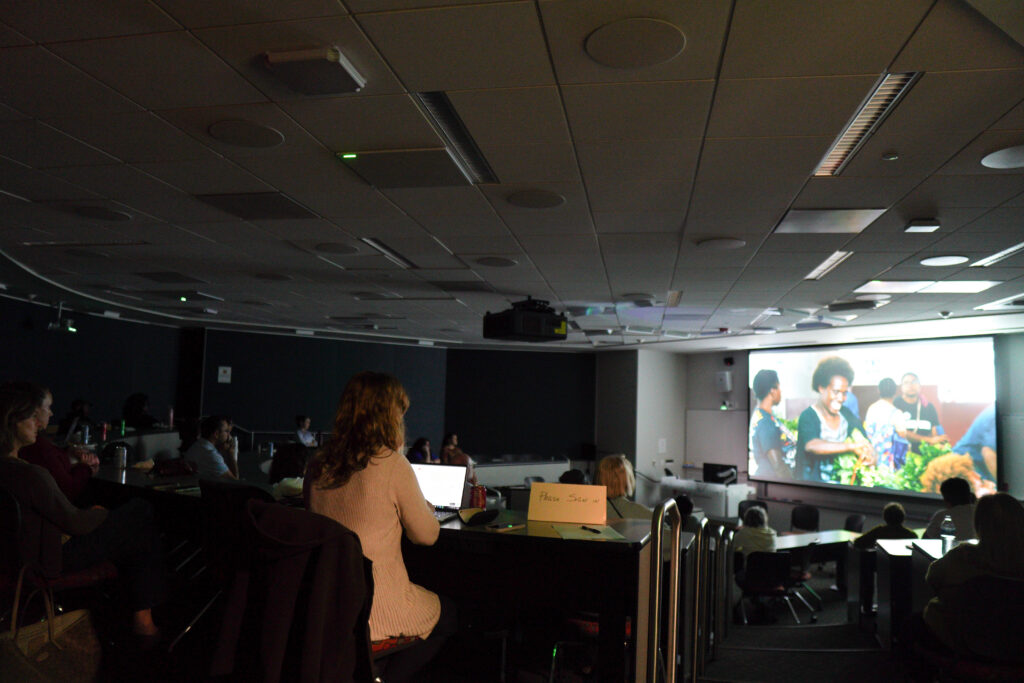
In a post-screening Q&A with Norton, Wise, and Andrew Hyde, the film’s director, Norton described his philosophy on strengthening local capacity, rather than dependency, when delivering humanitarian aid: “I took the approach to go to work to say, how do I make sure I’m not needed tomorrow?”
Norton recalled being troubled by the realization that an Australian or American doctor could fly to countries such as the Congo, “and just get off the plane and start treating people.”
“If a Congolese doctor got on a plane, arrived in New York or in Sydney, and treated the people, he’d be arrested,” Norton observed. “So, why is it different?” The solution to this inequity, Norton reminded the audience, is mutual respect.
Follow along with upcoming CIGH humanitarian health events here.